Showing posts with label Camille Smith. Show all posts

Tuesday, July 8, 2014

There is something special about Southeast Raleigh

In June and July, North Carolina Campus Compact will be publishing articles written by our VISTA members. These pieces give readers access to first-hand experiences and reflections of VISTAs serving throughout the state. We are excited for them to share their perspectives on community and service with us! 

Please note: Any opinions expressed on the VISTA VIEW blog are those of the authors and do not necessarily represent the views, opinions, or policies of North Carolina Campus Compact, the AmeriCorps VISTA program or the Corporation for National and Community Service.

By Camille Smith
NC Campus Compact VISTA at NC State University and the Raleigh College Center

When most people think of the Triangle area of North Carolina they think of tobacco road basketball rivalries, an exciting academic hub full of research and resources, great barbeque, and southern hospitality. When I became a Raleigh transplant four years ago, I quickly learned that this area is so much more than that. Raleigh truly is a magical place rich with history, creativity, charm and a small town feel with big city thinkers. I had been in Raleigh for two-and-a-half years before I was exposed to Southeast Raleigh. As a student at NC State, I had an opportunity to explore the different parts Raleigh via several internships in town, events, and social outings, but had never spent extensive time in the southeast area.

As I progressed through college, the reality that I was a student who had beaten the odds to get into college became more evident to me. I was one of those college students with limited resources and it was a miracle that I had the opportunity to attend an institution as full of resources as NC State University. My parents could not afford to send me to college so when I was in high school; I did everything in my power to ensure that I had a scholarship out of my hometown of Anderson, South Carolina. I worked hard to keep my grades up while excelling in volleyball. Like many minority high school students, I believed that my only ticket to college was through a sports scholarship. Luckily, I earned one at a historically black college, Virginia Union University. Although I loved my university, I decided to transfer at the end of my freshman year because I realized that what I wanted out of college was not offered at my university.  In 2010, I began as a sophomore at NC State University through a generous financial aid package and the grace of God. Almost immediately after my arrival to this behemoth state-funded school, I realized that students like me were rare and far between. For the first time in my life, I felt completely out of place and overwhelmed with a school environment.  I then began to reflect on my life, and how I got to this point. If it were not for the several mentors, teachers, counselors, friends, and family, in my life I would not have made to college nor would I have graduated. If it was not for their continuous support and guidance, I would not have seen it through and I would not have capitalized on the opportunities offered at NC State University. They showed me that, despite my background or upbringing, I not only belonged in college but could succeed.

Chavis Community Center
My experiences in life led me to my AmeriCorps position at NC State University. My title is Program Coordinator for an initiative created by Raleigh area higher education institutions, businesses, and community partners (also referred to as the Raleigh Colleges and Community Collaborative) entitled the Raleigh College Center. We believe that by promoting higher education access to under-represented youth in our community (specifically in Southeast Raleigh), that the cycle of poverty can be significantly reduced. I had the privilege of splitting my time between both NC State and the Chavis Community Center. My intention was to pay it forward to other youth who were like me, who did not have all of the resources, but who needed that push or exposure to knowledge on making it to a higher education institution.  What I have learned in this process is much more than I have expected!


A Brief History of Southeast Raleigh

First, I want to say that the Southeast area, is Raleigh’s best kept secret. The potential that lies in this region is just now being re-realized by city administrators, who are beginning to pour money and resources into this community, including the Raleigh Colleges and Community Collaborative.  When I say that the potential of this area is being “re-realized”, I mean that the residents of Southeast Raleigh understand their history and share a rare camaraderie that is deeply rooted and culturally aware, and it seems as though leadership in Raleigh has taken notice. I have been so fortunate to work in what I deem this community’s hub- The John Chavis Memorial Park and Community Center. Before I continue, I believe that it is only appropriate to give a brief history, for one to wrap their head around the amazingly talented children that I work with, who have been born and raised in this community.

Longtime Chavis staffer
and local resident Larry Wells
John Chavis Memorial Park is the largest community park located within walking distance to downtown Raleigh. Based on the history of this park, it is my belief that there is no better home for the Raleigh College Center! The park was established in the late 1930s by the city of Raleigh to serve the recreational needs of African-Americans during the Jim Crow laws. Prior to desegregation, Chavis was the largest recreational facility that was open to blacks from Washington, D.C. to Atlanta, with amenities such as a large swimming pool, playgrounds, a football field with seating, a baseball field, a carousel,  and picnic shelter.  The history that is embedded in the community center and the grounds around it is rich and frequently celebrated and echoed throughout the center on a daily basis. At least once a week I meet a new person that shares their John Chavis Park story. When I think of someone who has seen the transformation that the neighborhood has gone through, I think of twenty year Chavis Community Center staff member, Larry Wells, who grew up in the neighborhood and has frequented the park since 1961. In my time as a VISTA Larry’s insights about what makes Chavis what it is today, and his age-old wisdom have helped me put my volunteer duty into perspective. When speaking with other patrons of the Jim Crow generation, their eyes brighten up when bringing up memories of riding on a children’s train that toured the park, or learning to swim in what was then, the only pool that blacks could use in the region. It was a civil rights hub, where the Student Non-Violent Coordinating Committee (SNCC) organized marches from the park to downtown Raleigh. Ultimately, Chavis served as a safe and happy space when our nation was going through the civil rights movement.

Once desegregation was achieved, Chavis facilities virtually became frozen in time, and according to Mr. Wells, in the 1970s and 1980s the Southeast neighborhood began to experience higher crime rates.  He remembers attending high school at Ligon (now known as Ligon Middle School) when it was a thriving neighborhood in the early 1970s then returning later in the decade and becoming wrapped up in what the neighborhood had transitioned to. This once thriving historically black neighborhood surrounding John Chavis Park, was now becoming an alienated sector of Raleigh, with limited resources, and a growing pool of untapped potential. As Bob Geary wrote in a 2011 Indy Week article:

“Southeast Raleigh is a quarter of the Capital City. About 85,000 people live here, but they're not all the same. It's one of the fastest-growing parts of Raleigh, but some neighborhoods are in decay. It has a reputation for crime. There is crime. And poverty. You don't have to look hard to see it. But even in the worst parts of Southeast Raleigh, there's hope. In most of Southeast Raleigh, there's very little crime and the neighborhoods are middle-class—middle-class and still predominantly black.”

In local residents and Chavis staff members like Mr. Wells, I view this “hope” that Geary describes. There is a felt consensus in Southeast Raleigh for a yearning of growth and re-making it into the gem that it once was fifty years ago.

Fast forward to 2011

Southeast Raleigh is a hotbed for growth and opportunity, and several organizations have been created to uplift it and its residents. In 2010 the Bill and Melinda Gates Foundation, began to show interest in alleviating poverty in Southeast Raleigh. Businesses, community organizations, and all six colleges and universities in Wake County began to come together to rise to the challenge. Our community banded together to gain a $1.2 million dollar grant to invest in human capital through raising awareness about college access.

Cue the birth of the Raleigh Colleges and Community Collaborative and the subsequent establishment of the Raleigh College Center in 2012!

Raleigh youth visit Wake Tech, a member of the collaborative.
I serve as the second AmeriCorps VISTA in the growth of this initiative. My duties have been to expand our college access/youth serving network, collaborate with community partners, and act as Program Coordinator for the Raleigh College Center hosted workshops at the John Chavis Community Center.  What has been the most enriching part of this experience has been the ability to speak candidly with other youth serving individuals and youth in our community. Their perspective of Raleigh is both refreshing and innovative. In my opinion, these people are the true heroes of the future of our community. The youth that I work with are so vivacious and full of ideas for the future. Their savviness in communicating via technology is equally a generational barrier and an efficient method of communication and collaboration in the future. From my experience, I have found that the youth in southeast Raleigh, like many all over the country, have a separate and fresh way of
communicating with one another, but in some cases lack the confidence and tact that is required in speaking to others in person and in a professional setting. The Chavis Community Center provides a safe space for the teens in the area to build confidence through verbal communication, recreational activities, and by articulating their dreams at the Raleigh College Center.  The initiative and its partners have just begun to scrape the surface of the untapped potential of our community’s youth.

The College Center's 2nd Annual Etiquette Dinner
Within the past six months we have had an opportunity to connect with community partners such as Youth-Thrive, The WELL (Wade Edwards Learning Lab), Neighbor to Neighbor Outreach, YMCA Y-Achievers, 4-H, Habitat for Humanity, and more. We have collaborated with our partners to be innovative in the way that we expose our students to college. We have done everything from college visits, free test prep, personal finance courses, a local college fair, application readiness workshops, and even an etiquette dinner where college students taught our students the important of etiquette and
manners in today’s society!. 

The VISTA program with NC Campus Compact has allowed me to experience so many opportunities, that I otherwise wouldn’t have experienced at this point in my professional career. In the process of planning and implementing programs for the Raleigh College Center, I have been able to connect with professionals in higher education, local government, local educators, and the nonprofit field. Together, each of these people has contributed to the well-being of the students and families of Southeast Raleigh. My grandmother once told me that it takes a village to raise up a child, and the people whom I have encountered in my year of service serve as the village that has indirectly impacted the youth. Because of them, I was allowed to gain professional skills in public speaking by being asked to conduct college access seminars and speak in front of city council on the 2014 Mayor’s Day of Recognition for National Service. I have been able to network with Raleigh youth-services leaders at Youth-Thrive Training events. I even was asked to serve on a 40,000 Book Drive in partnership with Wake County Public School System and Wake Up and Read, where we raised well over our goal with 65,000 books!
Camille and other AmeriCorps members took part in the
Mayors Day of Recognition for National Service.

All of these experiences have shaped my viewpoint of Raleigh.  Although Raleigh is not short of its flaws and historical obstacles, it is quickly changing, and on the cusp of what many believe to be an urban explosion full of growth and even more opportunity. From my observations, I believe that it is extremely crucial to never forget the historical scars that have been left on the people of Southeast Raleigh, and use what has happened in this community to grow forward and in a positive manner.

As I move on to other places and other opportunities, I will never forget how my experience with poverty in Southeast Raleigh as an AmeriCorps member has been one of the most transformational seasons of my life. When I return to this community to visit, even after the current John Chavis Memorial Park and its Community Center transforms into the rightful community hub of the downtown Raleigh area, it is my hope that this community is still laced with a strong sense of history and strength that it has today. Being a VISTA in Raleigh during this time has opened my eyes to how I want to be a leader in my professional career and I have this amazing community to attribute to that.

Monday, April 7, 2014

NC Mayors recognize importance of National Service


mayors day
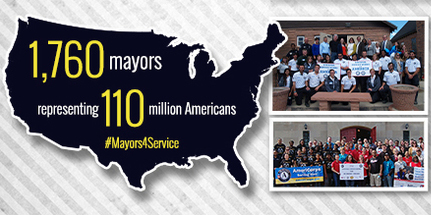
April 1st marked the second annual Mayor's Day of Recognition for National Service. Nationwide 1,760 mayors in all 50 states and the District of Columbia, Guam, and Puerto Rico united in support of national service. Thirty North Carolina mayors participated, which is a large increase from last year. A full list can be found here. Together, these mayors represent more than 110 million Americans, or one-third of the U.S. population. These mayors carried a common message: National Service Works for America. We at North Carolina Campus Compact were honored to participate in several of these events alongside such a diverse and vibrant group of AmeriCorps programs.

Dr. Lisa Keyne, Executive Director of NC Campus Compact, joined the Honorable U.S. Congressman David Price, Burlington Mayor Ronnie Wall; Gibsonville Mayor Len Williams; and Mr. Frank DiSilvestro, State Program Specialist with the Corporation for National and Community Service (CNCS), to recognize the commitment to service of the Alamance County RSVP Volunteers and local AmeriCorps members. The celebration was held in conjunction with a Ribbon Cutting Ceremony for the newly renovated Crump Village Education Resource Center, a community center that will provide educational space for residents of the Burlington Housing Authority as well as the broader community. BHA is also a key community partner of Elon University, and many Elon students support youth programming at Crump Village.

VISTA Camille Smith with a
signed proclamation of support
from Mayor MacFarlane
VISTA Jacob Lerner participated in an event in Chapel Hill with Mayor Mark Kleinshmidt and members of the NC Literacy Corps. VISTA Camille Smith participated in an event in Raleigh with Mayor Nancy MacFarlane. VISTA Anna Donze participated in an event in Winston-Salem with Mayor Allen Joines, and VISTAs Bevelyn UkahDevin Corrigan, and Carla Davis participated in an event in Greensboro with Mayor Nancy Vaughn. Each Mayor issued a proclamation of support to National Service and spoke of the importance of AmeriCorps initiatives happening throughout the city, and in many cases, throughout the State. VISTA Leader Carla Davis recounts her Greensboro event experience: "The feeling of community in the room was palpable as AmeriCorps members shared their service experiences and projects."

VISTA Anna Donze with other
AmeriCorps members & Mayor Joines
North Carolina Campus Compact is dedicated to leveraging higher education resources to support community organizations, and to create well-rounded programs that address K-12 education, hunger and homelessness, and food security. And we, with other AmeriCorps organizations, are working toward a common goal for North Carolina: to enhance the quality of life for its citizens. Currently the Opportunity Index ranks North Carolina 37th in the nation, but when we can align with local government, the speed at which this this goal can become a reality increases.

Thank you to all of our North Carolina Mayors for recognizing the work that North Carolina Campus Compact and each of our VISTAs is doing to mobilize college student volunteers, create partnerships with non-profits, and fight poverty. The Corporation for National and Community Service annually engages more than five million people in service at more than 60,000 locations in 8,500 cities across the country through AmeriCorps, Senior Corps, and other sponsored programs, and we are glad to be even a small part of those numbers.

Check out our Twitter feed for more Mayors Day pics and tweets @NCCampusCompact

Tuesday, December 3, 2013

VISTA Camille Smith reaches out at Raleigh College Center

VISTA Camille Smith shares info about area colleges.
While a student at NC State University, Camille Smith often found herself working in the Raleigh community. The Anderson, SC native led her alternative break team in monthly pre-trip service with Habitat for Humanity of Wake County, interned with Stop Hunger Now, and organized campus-wide service events as co-chair of the Student Government's Community Service Commission. But since becoming the Raleigh College Center VISTA in August, Camille is reaching out to new people and organizations, and learning about the city along the way.

"One of the highlights for me so far was the 75th Anniversary of the John Chavis Memorial Park, which served as a meeting place for segregated blacks leading up to the Civil Rights movement, and a gateway for community involvement for students of local HBCUs (Historically Black Colleges and Universities)," Camille explains. "I represented the Raleigh College Center, handing out brochures and our event calendar. It was a great chance to learn the history of the area and get to know the people the John Chavis Community Center serves. It is definitely one big happy family!"

As a VISTA, Camille supports the development of the Raleigh College Center (RCC), an effort hosted by the John Chavis Community Center in southeast Raleigh. The College Center opened in 2012 as part of the Raleigh Promise. The Promise is a collaboration among local higher education institutions, philanthropies, non-profits, businesses, and the City of Raleigh. The group's goal: double the number of low-income youth in Raleigh who earn a post-secondary credential and living wage employment by 2025. As a hub of college information for youth and families, the Raleigh College Center is a key part of the effort.

During her first few months in the VISTA role, Camille has started a weekly newsletter to share RCC events and keep the Promise partners informed. She has also helped coordinate college fairs and financial aid information sessions at Chavis, and worked with the Parks & Recreation Department's Teen Outreach Program (TOPs) to coordinate college visits for groups of local teens. The College Center also offers free SAT prep courses for community youth and has laptops available on site to turn the space into a computer lab.

Camille spends several days a week at Chavis, coordinating RCC programming and collaborating with community center staff. She also works out of NC State's Career Development Center, one of the lead administrative offices for the RCC. Dr. Kelly Laraway of the Career Development Center is Project Coordinator for the Raleigh Promise and Camille's VISTA supervisor.

"I'm thrilled with the College Center, seeing how it's going in a quality direction," says Dr. Laraway. "Camille is doing great. She's innovative, focused, and brings a new perspective to the project."

Major funding for The Raleigh Promise project was provided by a grant from the Gates Foundation. Since the grant period ended last summer, the collaborative has been planning next steps for the Promise project and for the College Center in order to sustain momentum toward its 2025 goal.

Camille looks forward to increasing the College Center's outreach and program offerings in the months ahead, to creating a way to evaluate participant satisfaction, and to streamlining the coordination and tracking of College Center presenters and participants.

Though she now loves living in Raleigh, Camille took some time finding her way to NC State. After high school, she attended Virginia Union University to play volleyball, but she realized it wasn't the right fit. After transferring to State as a sophomore, she became involved in Student Government and in programs organized by the Center for Student Leadership, Ethics, and Public Service, including several alternative break experiences. Camille led two trips to the Dominican Republic during her time at State, and she credits these experiences with cementing her desire to focus on community building. After she graduated in December 2012 with a BA in Political Science and minor in Nonprofit Studies, she learned of the NC Campus Compact VISTA program and the placement at the Raleigh College Center.

In her spare time, Camille enjoys running, attending Wolfpack sporting events, and taking advantage of the many festivals and special events in the state capital. She also volunteers her community relations skills as she spends time with friends who've started a local "community conscious design and apparel company" called Boss Manatee.

To learn more about the Raleigh College Center and receive the weekly newsletter, email Camille at casmit21(@)ncsu.edu.