Tuesday, June 17, 2014

Why Summer Learning Matters

By Grace Troccoli, VISTA Summer Associate at NC Campus Compact. Grace is a rising senior at Elon University, majoring in Special and Elementary Education and minoring in History. 

As a future teacher, nothing irks me more then when kids return to school in the fall and have forgotten all of their multiplication facts or have fallen several months behind in reading. Yet this phenomenon is a common occurrence in classes I work with and in other classes across America each fall.

Why? Because the lack of kids’ summer learning causes learning loss.
("Summer Learning Day")

In fact, studies since 1906 have consistently shown that most students regress in their learning during the summer. Over the summer, students have been shown to lose about two months of learning in math. Additionally, low-income students typically lose two months of learning in reading while their middle-class peers typically make slight gains in reading.  These consistent summer learning losses add up; summer learning loss accounts for two thirds of the ninth grade achievement gap in reading (Fairchild, 2008).

Yet despite these facts, an estimated 43 million children in the United States miss out on summer learning opportunities (Fairchild, 2008).This means that 43 million children in the U.S. are at risk for summer learning loss or are at risk for falling behind in school.

This reality is especially true for low-income families.  An analysis from an early childhood longitudinal study found that 46% of low-income children visited a library over the summer months compared to the 80% of their high-income peers who visited a library. 20% of low-income children visited an art, science or discovery museum over the summer while 62% of high-income children visited a museum.  Lastly, 43% of high-income children attended a camp over the summer while only 5% of low-income students attended a camp  (Blazer, 2011).

The disparities are great and the learning stakes are high, so what do we do about summer learning loss?

I am part of a VISTA Summer Associate program sponsored by AmeriCorps and North Carolina Campus Compact. Several of my fellow Summer Associates are supporting great summer learning programs. Here in Alamance County, Anna Lewis is supporting the Elon Academy which is a college access and success program for academically promising high school students with a financial need and/or no family history of college.  This summer the 69 scholars will spend a month on Elon University's campus taking college planning classes and academic enrichment courses in addition to participating in leadership development community service activities. Additionally, Jenna Nelson is supporting a program at the Boys and Girls Club that provides educational and leisure activities for kids in grades K-12.

In Madison County, NC, four Summer Associates are supporting the PAGE summer program. The Partnership for Appalachian Girls Education (PAGE) offers two, 3-week sessions for local adolescent girls from low-income families. The program focuses on digital literacy, college access, and literature while building on girls' critical thinking and leadership skills.

Other Summer Associates are supporting hunger-related projects that include nutrition education, which creates opportunities for summer learning on topics related to science and health. In addition to these programs, many other campus- and community-based programs across our state and nation are working to prevent summer learning loss.

If you care about summer learning loss, please join us in celebrating Summer Learning Day this Friday, June 20th! 

Summer Learning Day is a national advocacy day, sponsored by the National Summer Learning Association, that promotes the importance of summer learning.

There are many ways that you can celebrate Summer Learning Day!

For example, you can:
  • Celebrate Summer Learning Day with children you work with by: 
    • Reflecting with kids about what they want to learn this summer and help them form summer learning goals.
    • Creating a way to celebrate kids’ summer learning. For example, you could display kids' summer learning work around the room.
    • Implementing a long-term summer learning challenge. For example, you could challenge kids to read for a certain amount of minutes by the end of the summer. 
  • Spread awareness about the importance of summer learning in your community by sharing the Achievement Gap Info Graphic or Summer Learning Day Key Messages.
  • Spread awareness about Summer Learning Day through social media  by: 
For more ideas, check out the National Summer Learning Association’s suggestions here.


So, on Friday, June 20th, highlight the importance of summer learning in your community by celebrating Summer Learning Day and remember…

“You're never too old, too wacky, too wild, to pick up a book and read to a child.”- Dr. Seuss


Works Cited
Blazer, C. (2011). Summer Learning Loss: Why its Effect is Strongest Among Low-income Students and  How it can be  Combated. Information Capsule , 1011.  
Fairchild, R. (2008). Summer: A Season When Learning is Essential. Afterschool Alliance Issue Briefs (33).
"Summer Learning Day." National Summer Learning Association. N.p., n.d. Web. 03 June 2014.

Tuesday, June 10, 2014

Looking Back while Moving Forward: Reflections from an "organized" VISTA

Throughout the month of June, North Carolina Campus Compact will be publishing articles written by our VISTA members. These pieces give readers access to first-hand experiences and reflections of VISTAs serving throughout the state. We are excited for them to share their perspectives on community and service with us! 

Please note: Any opinions expressed on the VISTA VIEW blog are those of the authors and do not necessarily represent the views, opinions, or policies of North Carolina Campus Compact, the AmeriCorps VISTA program or the Corporation for National and Community Service.

By Devin Corrigan, NC Campus Compact VISTA at the University of North Carolina at Greensboro and the Interactive Resource Center

Hello from Greensboro!  As I wind down my service, I am reflecting on this year and some of the things I’ve learned.  I figured to share a few in my blog post.

1. Get Uncomfortable
Prior to my year as a VISTA, most of my interactions with “homeless people” were confined to my own silent deliberations about whether to part with spare change as I passed them on the streets.  So weak.  Since working at the Interactive Resource Center, I have gotten much more close and personal with homelessness.  I have been privileged to have raw, vulnerable conversations about HIV, domestic violence, addiction, incarceration, and poverty.  These conversations have completely changed my views.  Homelessness is truly something that happens to someone, not something someone is born with.

2. Service is chaos
Service is an odd stew of people with different motivations, intentions, goals, skills, and passions coming together to achieve the loose end of “doing good.”  It is not linear.  It is not cause and effect.  It doesn’t lend itself to check-boxes.  As someone who loves order, structure, and writing blog posts in list form, this was originally pretty disconcerting for me.  Being highly organized (see also rigid) works for me and was not necessarily something I wanted to give up.  I adapted by structuring my to-do lists with more “relationship-oriented” rather than results-oriented tasks.  Instead of organizing myself to “accomplish x, y, and z,”  I started framing my days around “reach out to a new IRC guest” or “get this student’s input about MLK Day marketing.”  I got a lot more accomplished and was able to build more of the relationships that make service rewarding.  At the end of the day, “doing good” happens even if it doesn’t look like what you anticipated.

3. Ask for help
For someone who is driven to “help” others, I have a pretty big aversion to asking for help myself.  It feels uncomfortable (see #1) and screams “I can’t do something.”  (God-forbid!)  However, this year has made me realize how willing people are to help when asked.  For example, very early on in the year we contacted dentists’ offices to donate toothbrushes for care packages for our IRC guests.  I didn’t think anyone would donate, but we were able to fill more than 60 care bags.  Since then I have tried asking for help more, whether that means saying “I don’t know how to handle this situation.  Can you help?” or “Can you show me how you design those fancy flyers?”  Asking for help usually says “I want to learn” and not “I can’t.”


4.  Figure out your outlets before you need them
Bad days will happen.  Things go wrong.  Buses cancel two days before the big event.  You drop the ball on a project. It’s important to build your safety net before you are falling.  Some things that I have found particularly cathartic are weekly “family” dinners with co-workers, running along the lake, and baking pies while blasting Marilyn Manson.  It’s comforting to know when you are feeling yucky, that a few things will make you feel better, even if the situation doesn’t change.

5. Laugh
A lot of awkward, random stuff is going to happen.  And it’s going to be pretty hilarious.  Seriously, all of my funniest stories are IRC stories.  Embrace it.


Wednesday, June 4, 2014

A Guide to Finding (Non-Student) Housing in Chapel Hill

Throughout the month of June, North Carolina Campus Compact will be publishing articles written by our VISTA members. These pieces give readers access to first-hand experiences and reflections of VISTAs serving throughout the state. We are excited for them to share their perspectives on community and service with us! 

Please note: Any opinions expressed on the VISTA VIEW blog are those of the authors and do not necessarily represent the views, opinions, or policies of North Carolina Campus Compact, the AmeriCorps VISTA program or the Corporation for National and Community Service.


By Sarah Cohn, NC Campus Compact VISTA at the Community Empowerment Fund in Chapel Hill

VISTA Sarah Cohn showing
CEF  and VISTA pride
I have so many unforgettable stories to share from my VISTA year at the Community Empowerment Fund. One particular story keeps resurfacing for me, though, at this point in time. This story is of Thomas, age 70, whose search for housing began last August when he found himself back at the shelter. In March, after finally saving up enough to put down a deposit, Thomas found the perfect one-bedroom within his budget. When he brought his application in to the realtor, he was told flat out, “We don’t rent to homeless people.”

My stomach turns even as I write these words. The coldness and lack of humanity are so tangible. How can a fellow human bear to keep someone just out of reach of the most basic of human needs? How can one overcome such discrimination? Thomas’s story brings a much debated issue to the forefront of my thoughts – affordable housing.

Let me explain that a little further. “Affordable housing” is an issue we hear about all the time, in news articles and on campaign platforms. Of course it’s scarce - who has ever had an easy time finding an apartment within their budget that’s perfectly suited to their needs? But in some communities, the lack of affordable housing takes on a whole new meaning. One widely accepted definition of affordable rent is 30 percent or less of your income. The US Department of Housing and Urban Development (HUD) is no stranger to this norm, affirming that “families who pay more than 30 percent of their income for housing are considered cost burdened and may have difficulty affording necessities such as food, clothing, transportation and medical care”. For someone who works full time at minimum wage, this should mean roughly $377 per month. And that’s working 40 hours every week of the year, before taxes. In Chapel Hill, the average rent for a one-bedroom apartment ranges from $833 - $1,213. This is 2-3 times what that full-time worker can afford, leaving them with limited options: find a higher-paying job, move out of town, or possibly become homeless.

Our country’s paucity of affordable housing is well established, and I could prove so with dozens more numbers. But for a moment, let’s imagine that affordable housing is plentiful. Minimum wage has been increased to an actual living wage, perhaps around $12.00 per hour, and rental prices have come down. That same full-time worker can now put in applications with several rental companies. But what about the other barriers that can prevent someone from finding housing? To name a few, these are: bad credit, a criminal record, negative past rental history, not making three times your rent in monthly income, socioeconomic or racial discrimination, or, if you are a subsidy recipient, landlords not willing to accept your voucher. It turns out that the raw lack of affordable places to live is just one item on a long checklist of barriers to finding housing.

Last year, General Services Corp. (GSC) bought the majority of Orange County’s largest apartment complexes. GSC refuses to accept Housing Choice Vouchers (formerly known as Section 8), HUD’s housing subsidy program designed to supplement minimum wages and benefits to allow community members to rent at market value. The corporate buyout displaced many families last year and will displace dozens more in the coming months. CEF is one of many organizations that will provide services and advocacy to such individuals and families as they begin a complex and trying process. A housing crisis has dawned in Chapel Hill.

And it’s not just GSC – many private landlords don’t accept Housing Choice Vouchers, either. In North Carolina, they don’t have to. Although the vouchers allow tenants to pay full rent, their rent check is coming from the federal government, which means much paperwork and an inspection are required. Why would any landlord, let alone a huge corporation headquartered states away, want to spend time on paperwork and inspections when they can easily target college students and charge even more? It’s a simple business decision, but one that reeks of discrimination.

Did I mention that the Housing Choice Voucher wait list in Orange County has been closed for over two years? If you don’t already have a voucher, your options for assistance are minimal to none. Better get to working that full-time job (if you’re lucky enough to get one – that’s a whole other set of obstacles) so you can start making not nearly enough to pay market rent!

The barriers to finding housing in Orange County are multiple, layered and woven into other systems of oppression and poverty. I am grateful to be part of an organization willing to adapt to changing social conditions and to advocate for others, but there is so much more that needs to happen. For now, I hope that CEF and our community partners can lend advocacy to all those trying to navigate the ever-growing obstacle course that is finding a place to live. For the long-term, I hope we can all invest a little more heart in our own communities.

You can learn more on local and national housing initiatives by watching this video for the Penny for Housing Campaign in Orange County or reading this article about The 100,000 Homes Campaign, a national effort with a task force here in Orange County.

Monday, June 2, 2014

VISTA Quarterly Report: Leveraging Resources for Long-term Impacts

Here's an update on how our VISTA members are mobilizing North Carolina's communities and
VISTA Willie Jones grows garden
program, Photo Credit: Tanner Hall

 continuing to fight poverty with the power of higher education!

Our measurable impact from the past four months:
  • $49,495 cash and grant resources generated
  • $7,221 in-kind resources generated 
  • 1,751 volunteers mobilized
  • 13,070 hours of service performed by volunteers
To date, our VISTAs and the programs and organizations they support have improved the lives of individuals:
  • 176 low-income people received housing-related or financial literacy services
  • 180 at-risk students completed participation in an education assistance program
  • 117 at-risk youth/mentor matches were sustained for the required time period
  • 11 new service programs met needs of low-income people or at-risk K-12 students and 72 new volunteer recruitment, management, and training processes supported these service programs.
VISTA Jess-Mara Jordan promotes Open
Doors' Annual Art Auction on the news
VISTA Jess-Mara Jordan transformed the STRIVE mentoring program at Open Doors of Asheville into a UNCA service-learning class for credit, and created a mentor curriculum which includes training on cultural competency, non-parent role models, college exposure, and much much more. Jess also volunteered at "Open Doors' Annual Art Auction" which raised $100,000.

VISTA Willie Jones turned his gleaning program into a gardening club to create a critical base of volunteers year-round. He and the new club members gleaned and secured 712.5 pounds of food this past quarter through the Fill-the-Bag Food Drive, which goes to the Community Table and other Cullowhee food pantries supporting over 25,000 people over the course of a year. His work was featured in this local news article. Apart from Willie's primary gardening and food distribution projects, he also helped raise over $3,000 for "The Unbroken Circle" Fundraiser, to support the victims of the mudslide in Oso, Washington and their families in Western North Carolina. Willie also participated in the "Cullowhee Fire Fundraiser", to benefit the victims of a fire which consumed 3 local businesses and left almost 30 workers displaced. 

VISTA Brittany Johnson secured a building location for Hospitality House of Boone's Thrift store! Once the store is operational, it will create a sustainable source of revenue for the organization. She is now developing a volunteer and recruitment program for volunteers to work at the store, teaming up with ACT to recruit Appalachian State University students. The 5k Memorial Day Fundraiser, notably named the "Color Blast", will support start-up costs for the thrift store.

VISTA Jacob Lerner with the Marion Cheek Jackson Center in Chapel Hill piloted a landlord research team to better determine students' relationships with landlords and what impact these relationships have on the community, and has also developed a student outreach team to help build networks among neighbors, learn more about what neighbors' issues, and connect folks with information about the Jackson Center. Jacob also supports volunteer efforts at the Heavenly Groceries food ministry, which welcomes close to 80 people each day, who then go home and feed their families. Jacob also had $600 worth of food donated to feed 300 people for the Marion Cheek Jackson Center's annual May Day Celebration.

HPU Bonner Leaders tutor students at
the Macedonia Family Resource Center
Photo Credit: HPU Bonner FB page
VISTA Anna Mahathey at High Point University worked with the Bonner Leaders Program to develop Bonners Chats, inviting students and community members alike to discuss and learn about poverty, food insecurity, and other social justice issues specific to High Point. Their Chats included topics entitled "Childhood Literacy, Poverty, & the Impact it has on Children in School," , "Putting a Face on Homelessness," and "Immigrant and Refugee Justice," The chats engaged over 50 people.

VISTA Bevelyn Ukah at Guilford College launched the African Youth Initiative (AYI) Youth Advisory Board with 5 youth and 4 interns. In collaboration with the board, Bevelyn secured a $1,500 grant from the Community Foundation Teen Grantmaking Council  to support AYI Youth Ambassador operational functions. This advisory board creates space for youth ownership, learning, and creativity, and has most recently been focusing on food security. They have partnered with the Food Youth Initiative through the Center for Environmental Farming Systems to discuss forming a community garden and supporting local food education. 

VISTA Erin O'Donnell works with low-income Wilmington residents who not only participate in the Rent-A-Farmer CSA Produce Box program and Feast Down East's Fresh Market, but who also collaborate in planning and implementing new Feast Down East Projects. Erin worked with local farmers to donate $265 worth of fresh organic produce to these programs as well.

VISTA Ariel Mitchell at Lenoir Rhyne hosted several food drives for her community partner, Centro Latino, her largest spanning 15 days to end on National Volunteer Week. They collected over 200 food items to support Centro Latinos' emergency food bank. 

VISTA Takira Dale at Duke University's Community Service Center incorporated a donation drive into her Alternative Spring Break "Dive Into Durham", to donate 150 hygiene kits for Urban Ministries of Durham.

PAGE program youth working on
digital media project
VISTA Elizabeth McIntosh recruited 7 interns to support the PAGE summer program, an educational enrichment program for which she recruited 30 middle school girls. The program is set to launch on June 17th. Elizabeth developed a new partnership with Hot Springs Learning Center, and received sponsorships from both local groups such as the Presbyterian Women's Association, as well as groups at the corporate level including the Community Foundation of Central Florida. Most recently, she received a donation from a local family to start a Farm to Table initiative to address food insecurity in Madison County, and at PAGE's summer camp, where the participants will learn about healthy eating and farming.

VISTA Camille Smith spearheaded the Wake Up and Read Book Drive, which collected over 67,000 children's books to increase literacy in Wake County!

VISTA Sarah Cohn at the Community Empowerment Fund in Chapel Hill trained and supported 25 volunteer advocates this quarter, who in turn worked with 176 people experiencing homelessness to provide housing-related support. Forty-three of those 176 folks also attended financial literacy classes. Not only does Sarah match volunteers with clients, this quarter she also created an impact evaluation framework for CEF. The framework lays a foundation for CEF to improve data collection methods over time to better understand how CEF can meet client needs.

VISTA Shifra Sered recruited teachers and designed the program for "Arts on Third Street," in which 40 low-income youth in west Greenville participated. Shifra's primary achievement has been the creation of  a 30 page volunteer manual and the design of a volunteer orientation to support educational programming at the Third Street Community Center.

Queens University mentor with his
Sedgefield Elementary mentee
VISTA Christina Hudson sustained mentor relationships of Queens University students as pen pals, lunch buddies, and
after school care tutors and classroom assistants to students at Sedgefield Elementary. These efforts were supported by the elementary school's new emailing system informing volunteers of different opportunities to get involved. Christina also teamed up with Promising Pages to donate 398 books to Sedgefield, enough to start a new library.

The North Carolina Campus Compact VISTA impact spreads far and wide, and with it goes the word about AmeriCorps VISTA. One of our VISTAs shared, "I spread the word about AmeriCorps everywhere I go. I personally feel I can't tell people what I do or am trying to do without promoting AmeriCorps."

Read more about our VISTAs' work on Alternative Spring Break trips and MLK Days of service, and Devin Corrigan's large-scale MLK Day event in Greensboro. And if you missed our earlier project updates, learn about the rest of their work.

Wednesday, April 30, 2014

Campus Compact and AmeriCorps Alums seek feedback from current VISTAs and alums

Attention current and former NC Campus Compact VISTAs! AmeriCorps Alums and National Campus Compact want to know about your VISTA experience. These organizations are both committed to constantly improving the national service experience, and these surveys help them do that.

Here you will find the 2014 National Campus Compact VISTA Evaluation Study. Your responses will help National Campus Compact to evaluate each of their different VISTA programs and the impact that your service has had on you since you completed your term.

Depending on how you answer, the survey is around 50 - 75 questions long and should take you around 20 - 30 minutes.

If you have any questions, please contact Mark Este from Campus Compact at meste[@]compact.org.
Please make sure to use Mozilla Firefox when completing this survey. Don't delay, the deadline to share your feedback is May 2nd!

Here you will find the survey from the AmeriCorps Alums network. This survey asks questions about your experience as a corps member and as an AmeriCorps alum. Your input will help AmeriCorps Alums understand the effectiveness of the alumni program, and will allow AmeriCorps Alums to better meet the professional and educational development needs of alums like you. If you served in more than one AmeriCorps position, please answer the survey questions about your most recent AmeriCorps position, when applicable.

This survey should take approximately 10 minutes to complete. At the end, to thank you for your time, you can enter into our drawing to win one (1) hour of one-on-one coaching with a professional career coach or one (1) ticket to attend the invite-only National Service Summit in June 2014!

For any questions or concerns, please contact: survey2014[@]americorpsalums.org

Monday, April 7, 2014

NC Mayors recognize importance of National Service


mayors day
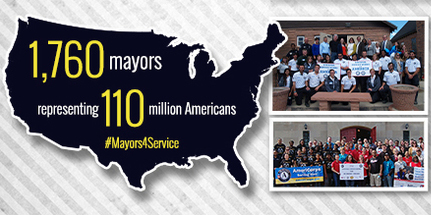
April 1st marked the second annual Mayor's Day of Recognition for National Service. Nationwide 1,760 mayors in all 50 states and the District of Columbia, Guam, and Puerto Rico united in support of national service. Thirty North Carolina mayors participated, which is a large increase from last year. A full list can be found here. Together, these mayors represent more than 110 million Americans, or one-third of the U.S. population. These mayors carried a common message: National Service Works for America. We at North Carolina Campus Compact were honored to participate in several of these events alongside such a diverse and vibrant group of AmeriCorps programs.

Dr. Lisa Keyne, Executive Director of NC Campus Compact, joined the Honorable U.S. Congressman David Price, Burlington Mayor Ronnie Wall; Gibsonville Mayor Len Williams; and Mr. Frank DiSilvestro, State Program Specialist with the Corporation for National and Community Service (CNCS), to recognize the commitment to service of the Alamance County RSVP Volunteers and local AmeriCorps members. The celebration was held in conjunction with a Ribbon Cutting Ceremony for the newly renovated Crump Village Education Resource Center, a community center that will provide educational space for residents of the Burlington Housing Authority as well as the broader community. BHA is also a key community partner of Elon University, and many Elon students support youth programming at Crump Village.

VISTA Camille Smith with a
signed proclamation of support
from Mayor MacFarlane
VISTA Jacob Lerner participated in an event in Chapel Hill with Mayor Mark Kleinshmidt and members of the NC Literacy Corps. VISTA Camille Smith participated in an event in Raleigh with Mayor Nancy MacFarlane. VISTA Anna Donze participated in an event in Winston-Salem with Mayor Allen Joines, and VISTAs Bevelyn UkahDevin Corrigan, and Carla Davis participated in an event in Greensboro with Mayor Nancy Vaughn. Each Mayor issued a proclamation of support to National Service and spoke of the importance of AmeriCorps initiatives happening throughout the city, and in many cases, throughout the State. VISTA Leader Carla Davis recounts her Greensboro event experience: "The feeling of community in the room was palpable as AmeriCorps members shared their service experiences and projects."

VISTA Anna Donze with other
AmeriCorps members & Mayor Joines
North Carolina Campus Compact is dedicated to leveraging higher education resources to support community organizations, and to create well-rounded programs that address K-12 education, hunger and homelessness, and food security. And we, with other AmeriCorps organizations, are working toward a common goal for North Carolina: to enhance the quality of life for its citizens. Currently the Opportunity Index ranks North Carolina 37th in the nation, but when we can align with local government, the speed at which this this goal can become a reality increases.

Thank you to all of our North Carolina Mayors for recognizing the work that North Carolina Campus Compact and each of our VISTAs is doing to mobilize college student volunteers, create partnerships with non-profits, and fight poverty. The Corporation for National and Community Service annually engages more than five million people in service at more than 60,000 locations in 8,500 cities across the country through AmeriCorps, Senior Corps, and other sponsored programs, and we are glad to be even a small part of those numbers.

Check out our Twitter feed for more Mayors Day pics and tweets @NCCampusCompact

Tuesday, April 1, 2014

VISTA-led alternative break trips and “service staycations” expand student learning, service


NC Campus Compact AmeriCorps VISTAs helped lead Alternative Spring Break trips near and far this past month, engaging students both in service and in meaningful reflections of the experience to connect with their day-to-day lives. Each ASB trip built on the VISTA's primary project focus: k-12 education, economic opportunity, or food security.

VISTA Dalton Hoffer co-led a trip to the national historic city of Philadelphia for packed week of activities and service opportunities. The group served four different community organizations in the area: Philabundance Food Bank, Jewish Relief Agency, Philadelphia Reads, and Cradles to Crayons. These agencies allowed them to learn how Philadelphia is working on improving its literacy rate and interacting with volunteers. The students then took that knowledge back to Robeson County which also holds a low literacy statistic. Six of the 9 participating students are mentors in the Brave Impact Mentoring Program Dalton helped create. Focusing on leadership and citizenship, Dalton said the trip "allowed [the mentors] to work with and see how other partners utilize volunteers and interact with students" and led to conversations about how to bring that work back to Robeson county and inspire a sense of pride in that work throughout the community. Check out Dalton's video recap of UNCP's trip.

VISTA Anna Donze at Wake Forest University focused her trip in the community by hosting a Staycation at her community partner site, El Buen Pastor Latino Community Services. Typically the site struggles during WFU's Spring Break as it loses the majority of its volunteer tutors for a week. The 7 WFU students on the trip served as tutors for the duration of the week, played with and supervised the elementary students during their free time and volunteered in the garden. One WFU student said of the experience, "We are helping nurture, mentor, and guide our next generation of youth. We are putting our heads together to care for the young people that will impact this world in years to come." They also designed and led a "Vocab Bowl" for the students to practice some vocabulary words that they may not use in the classroom, as the majority of the students speak only Spanish at home. Anna not only helped coordinate the trip, but also took note of the week's highlights to incorporate them next year for Staycation round two.

VISTA Takira Dale with the Duke Community Service Center also stayed close to home to host her Dive into Durham ASB trip. During this 5 day service experience, Takira and her supervisor, Assistant Director of CSC Programs Dominique Redmond, led 10 students working with various community agencies including Duke Gardens, Urban Ministries of Durham, the Durham Food Bank, Habitat for Humanity, Genesis Home, Lakewood Community Garden, and the West End Mobile Market. These agencies are committed to fighting hunger and homelessness in Durham, and align with Takira's primary food security project through the Community Service Center. After the service events, Takira led reflection discussions and panels, and created a contact list for these student volunteers to stay engaged in the community throughout their undergraduate career and into their futures. She said of the week, “One interesting aspect of this ASB was experiencing the wide variety of people working on solving issues of homelessness, hunger and poverty. All these organizations may have different methods but most are surprisingly interconnected.”

WCU students conducting food
assessment surveys for the Lower
Nine Ward Food Coalition
VISTA Willie Jones also focused on food security and homelessness for his ASB, a complement to his primary project at Western Carolina University where he is establishing a volunteer gleaning program and reinvigorating the campus garden. Willie and his supervisor Dr. Lane Perry, Director of the Center for Service Learning, led a group of 17 students to New Orleans to work with Green LightThe Green Project, and Lower Nine, all organizations who's focuses are to alleviate hunger and homelessness. Willie says, "This was the first time WCU has traveled to NOLA and the first time [WCU] has worked with any of these partners." The Center for Service Learning is currently developing a system that will allow the university to have multiple alternative break locations that can be rotated out on a yearly or bi-yearly basis. "This way," Willie says, "the university will be able to maintain the relationship they built with these communities." Willie served as the food insecurity and gardening expert for the group.

ECU students maintaining a rain
garden at a local elementary school
VISTA Shifra Sered co-chaperoned a group of 9 East Carolina University students on their ASB trip to Carteret County, North Carolina, where they stayed at Camp Albemarle; ECU's long-time ASB host. The group served primarily at NC Coastal Federation, but also served with Habitat for Humanity and the Hope Mission soup kitchen. "By living in an intentional community and learning to rely on one another for support," Shifra said, "we were able to delve into service and educational experiences that challenged us to evaluate and articulate our values surrounding community, inequality, social responsibility and environmental justice." The group immersed themselves in the experience in part by limiting their food budget to the current food stamp allocation, and by adopting the sustainable lifestyle practices they learned through their service. Shifra designed and facilitated educational and reflection activities for the students as well. She says that after the trip, "We charged all of the student participants...to design and implement a sustainability project back at ECU...[which will hopefully] lead to a student-run sustainability club on campus."

VISTA Bevelyn Ukah and her supervisor James Shields, led a group of Guilford College Bonner Leaders to Charleston, South Carolina and St. Helena Island to learn about the history and contemporary realities of the Gulla Geechie nation, specifically as they relate to race and class relations in the area. The goal of this trip was to give the students the practice working in teams to analyze poverty and diversity using place-based critical thinking. 

NC Campus Compact's very own Office Manager, Rene Summers, also co-led a group of 9 Elon University students on a mission trip all the way to St. James Jamaica to serve with an organization called Mustard Seed Communities, which serves children with special needs. The group spent part of their trip with the children and the other part completing projects ranging from light construction work, painting, farming and landscaping alongside the community and MSC staff. Rene and the group arrived safely back in Elon this week, but they will continue to hold meetings to reflect on their experiences.

All of these VISTAs have been planning their trips for months. Though each of project may seem different, the goal of all is to engage students in a deeper conversation with and understanding of their communities. Whether the groups went North to Philly, South to NOLA, stayed in the state, or stayed right in their neighborhood, NC Campus Compact VISTAs are shifting the conversation these students are having and preparing the next generation of leaders and community organizers.   

More information about organizing and implementing alternative break programs can be found on the NC Campus Compact website on our Alternative Break Resource page.   

One student from from Takira Dale's Dive into Durham aptly sums up the ASB mindset: “Volunteering is so easy and refreshing, we should do it more often…I have no good reason to not be doing more.”